
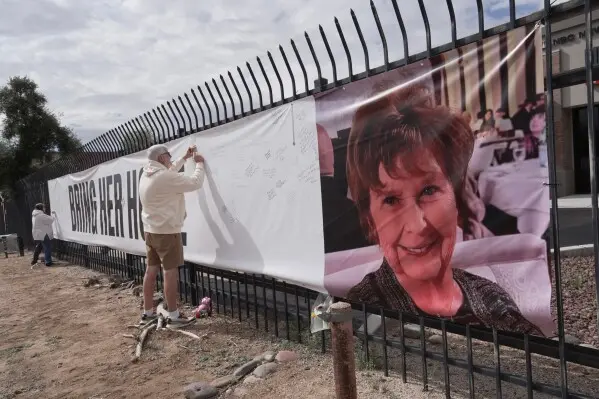

A s the disappearance of Nancy Guthrie, the 84‑year‑old mother of NBC’s Today show co‑anchor Savannah Guthrie, enters its third week, retired law enforcement experts — including a former Dayle Hinman - style criminal profiler — are offering insight into the complexities and peculiar details of the case that have stumped investigators and drawn national attention.
Guthrie was last seen on January 31 at her home in the foothills outside Tucson, Arizona. Her disappearance was reported the following day when she failed to attend a scheduled virtual church gathering. Despite extensive searches, the involvement of federal and local law enforcement, and the release of evidence including surveillance footage and forensic clues, authorities have not made an arrest.
Surveillance Footage and Forensic Evidence
Investigators released video footage showing a masked individual outside Guthrie’s home around the time she vanished. The suspect, captured on a doorbell camera, was wearing gloves and carrying a backpack, prompting a widespread public appeal for tips. In a potentially significant development, the FBI announced on February 15 that DNA extracted from a glove found near Guthrie’s residence appears to match the gloves worn by the individual in the surveillance footage, though the official confirmation was still pending analysis in a national database.
The Pima County Sheriff’s Department has declared the property a crime scene and continues to comb the area for additional leads, while sharing key details with the public to help identify the suspect. Savannah Guthrie and her family have issued emotional pleas for her mother’s return, emphasizing hope despite the lack of direct contact from anyone claiming to have her.
Former FBI Profiler Analysis
A former FBI criminal profiler — speaking on national broadcasts and to media outlets covering the case — said the Guthrie disappearance exhibits some “highly unusual” elements that distinguish it from more typical abductions or opportunistic crimes. Experts with behavioral science backgrounds noted that the absence of an immediate ransom demand, the method of the suspect’s approach and departure, and the public nature of the case all present investigative challenges.
“It’s not normal in a typical custodial kidnapping — you see direct contact with the family right away, especially when ransom is the motive,” one former FBI profiler told NewsNation. She explained that experienced kidnappers who are seeking money tend to minimize attention by making contact privately and quickly, rather than relying on media or delayed communications.
The profiler noted that the presence of purported ransom notes in the media — some of which have been treated skeptically by law enforcement — complicates the narrative. Investigators usually look for traceable communications and opportunities to analyze writing or digital footprints, but inconsistent ransom communications can divert resources or raise questions about the perpetrator’s intent.
Why This Case Is “Unusual”
Retired FBI experts emphasize several aspects of the Guthrie case that differ from more typical kidnappings:
- No confirmed ransom contact: Skilled abductors often make immediate contact to negotiate payment. In this case, authorities and the family have not verified any credible direct communication from someone claiming to hold Guthrie, beyond disputed notes circulated in the media.
- Evidence at scene: The presence of Guthrie’s blood on the porch and forensic indicators inside the home suggests a struggle or forced entry, but does not clearly point to motive.
- Masked intruder and amateur behavior: Surveillance footage shows an individual tampering with Guthrie’s camera, but some profilers describe aspects of the suspect’s conduct — such as not immediately removing surveillance devices — as inconsistent with professional criminal tradecraft. This could indicate an inexperienced perpetrator or one driven by motives other than traditional ransom.
These kinds of “red flags” make it harder for investigators to apply standard behavioral profiles, leading to a broader range of theories that must be evaluated carefully.
Theories on Motive and Pattern
Experts suggest several possible motives, each with different investigative implications. Random abductions of elderly individuals are rare, but they do occur, and in such cases, law enforcement often works to rule out personal or targeted motives first.
One former profiler pointed out that cases where an elderly victim is abducted without immediate ransom contact can sometimes indicate motives unrelated to money — such as personal vendettas, opportunistic crime, or even motives tied to family or community connections. However, she also cautioned that there is no firm evidence pointing to Guthrie’s social circle at this stage.
Another former agent noted that the lack of immediate professional negotiation or communication is striking. “If someone intended this to be a ransom kidnapping, they would typically make contact with the lowest common denominator first — law enforcement or the family directly,” the expert told NewsNation.
Search Efforts and Public Appeals
Law enforcement has canvassed neighborhoods, issued composite images of the suspect, and provided descriptions of the backpack and clothing seen in footage. The FBI’s involvement includes outreach to private sector partners to analyze surveillance and database connections in hopes of narrowing down leads. Public cooperation remains a key component, as authorities sift through thousands of tips that may hold critical clues. Savannah Guthrie has repeatedly appealed for her mother’s return, using social media and televised statements to urge whoever may be in contact with her to provide verifiable proof of life. These emotional appeals serve both to maintain public awareness and potentially trigger a response from those with information.
Investigative Challenges
Experts observe that high‑profile cases like Guthrie’s can attract a wide range of theories, rumors, and false leads, making the vetting process for tips extremely demanding. Behavioral analysts and criminal profilers often work in conjunction with law enforcement to help prioritize the most credible information, especially when media attention creates noise around the case. Another complicating factor is the evolving landscape of digital communication. Law enforcement agencies now face challenges in confirming genuine communications versus hoaxes or misleading ransom notes, particularly as technology facilitates fabricated messages or deepfakes. While authorities have cautioned against relying solely on digital contact as proof of life, this modern complexity adds another layer to the investigation.
What Investigators Are Watching
As the FBI and Pima County Sheriff’s Department continue their work, key investigative avenues include:
- DNA analysis: Forensic testing of gloves and other physical evidence to identify suspects.
- Surveillance matching: Comparing public and private camera footage to track suspect movements.
- Public tips: Vetting thousands of submissions and eliminating leads that lack substantiation
Retired profilers emphasize patience, noting that cases with limited early breakthroughs can still be resolved — sometimes through a single overlooked detail that leads investigators toward clarity. Their experience also suggests that complex investigations often evolve as forensic evidence intersects with behavioral patterns.
Hope and Continued Awareness
While experts underline the difficulties of the case, they also stress that without a confirmed motive or suspect, all investigative options must remain open. Encouragement for public vigilance and cooperation continues as authorities urge anyone with relevant video footage or information to come forward. For the Guthrie family, maintaining public attention and applying expert insight to evolving evidence are essential parts of sustaining hope that Nancy will be found and that the circumstances of her disappearance will eventually be understood and resolved.