
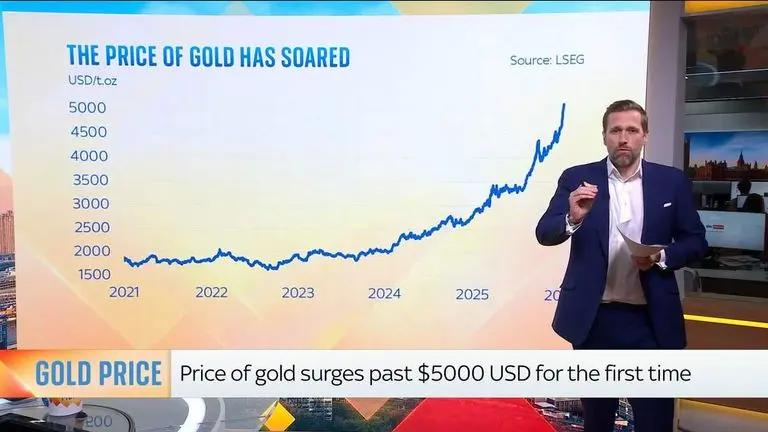
T he price of gold has gone above the previous record high of $5,000 per ounce and doesn't seem to be going down as investors look for safety from the uncertainty surrounding Donald Trump. Gold reached a record high of more than $5,100 per ounce on Monday, continuing a historic rise as investors flocked to the safe-haven asset in response to rising geopolitical risks. On Monday, gold hit a new all-time high of $5,100 per ounce. This is part of a record-breaking run as investors look for safety in the yellow metal because of rising geopolitical tensions and worries about the global economy.
At 0656 GMT, spot gold was up 2.2% to $5,089.78 per ounce. It had reached an all-time high of $5,110.50 earlier. Spot gold prices went up 2.4% to $5,102 per ounce, but then they lost some of their gains and ended the day at $5,086. Gold futures for delivery in February in the U.S. went up 2.2% to $5,086.30 per ounce. In the U.S., gold futures for February went up 2.1% to $5,087 an ounce.
Why This News Matters:
Gold costs more than$5,000 an ounce, which is a major issue and illustrates that people all across the world are scared. Investors are rushing to safe havens because of political instability, risks to trade, swings in currency prices, and worries about the Federal Reserve's independence.
They no longer have faith in traditional assets. The price of gold has gone up so swiftly and by so much that it suggests that this isn't simply a short-term fear; people tend to pick safety over risk.
Safe-Haven Demand and Trump-Related Uncertainty
The commodity, which has traditionally served as a safe haven for investors during difficult times, has been in great demand during theUS president's second term. It has become recognized as a helpful hedge against volatility caused by on-going trade disputes and other concerns.

Gold has been particularly sensitive to US military action in Venezuela, the prospect of strikes on Iran, disagreements between President Trump and America's NATO partners over Greenland, and, most recently, his repeated tariff threat against Canada. On Wednesday, US President Donald Trump dramatically reversed his plan to slap tariffs on European allies as leverage to grab Greenland.
Over the weekend, he stated that if Canada followed through on a trade agreement with China, he would levy a 100% tariff. He has also threatened to impose 200% tariffs on French wines and champagnes in an apparent bid to get French President Emmanuel Macron to join his Board of Peace project. "The latest catalyst is effectively this crisis of confidence in the US administration and US assets, which was triggered by some of the Trump administration's erratic decision-making last week," said Kyle Rodda, a senior market analyst at Capital.com. "This Trump administration has caused a permanent rupture in the way things are done, and so now everyone's kind of running to gold as the only alternative," according to Rodda.
Yen Volatility Spurs Intervention Fears, Lifts Gold
A decline in the yen has also unsettled markets, with investors expecting policy assistance from the US and Japanese central banks to stabilize the latter's currency. The yen has fallen to multi-decade lows against the pound and record lows against the euro in response to Japan's ultra-low interest rates.
- Yen weakness rattles markets
- Intervention fears rise
- Dollar slips broadly
- Fed independence questioned
Meanwhile, a rising yen dragged the dollar broadly down on Monday, with markets bracing for possible yen intervention and investors reducing dollar positions ahead of this week's Federal Reserve meeting. A lower dollar makes greenback-priced gold cheaper to holders of other currencies.
Another reason driving gold demand is market concern over the future of the United States' central bank, the Federal Reserve. Its latest rate-setting decision this week is clouded by a criminal probe of its chairman, Jerome Powell, whose term expires in May. There is speculation in the US media that Mr Trump, who is dissatisfied with the pace of interest rate decreases, will nominate Mr Powell's successor this week. The name has the potential to exacerbate market concerns about the bank's independence.
Analyst Commentary on Market Stress
According to Ipek Ozkardeskaya, senior analyst at Swissquote, there was no new escalation over the weekend, including no infringement of international law, invasion, or urgent military threat. The US did, however, warn Canada with 100% tariffs after Mark Carney approached China last week, defying the White House - a reminder that trade concerns are still very much alive. "Beyond that, the news flow is thin. Yet the bid for precious metals suggests that market stress is far from over." "The recent further leg up in gold and silver prices has arrived on the back of geoeconomics issues related to Greenland," HSBC noted in a note last week.
Last year, gold prices rose by 64%. The metal increased by 64% in 2025, its largest annual rise since 1979. Prices have reached successive new highs in the last week, and they have already grown by more than 18% this year.
Rising precious metals signal ongoing market stress
Outlook and Forecasts
Given the unprecedented run of events that has occurred in recent weeks, major institutions have rushed to raise their projections for gold prices in 2026. Analysts predict that gold prices will rise further this year, reaching $6,000, due to rising global tensions and strong central-bank and retail demand.
“We expect further upside (for gold). Our current forecast suggests that prices will peak at around $5,500 later this year,” said Philip Newman, director of Metals Focus. "Periodic pullbacks are likely as investors take profits, but we expect each correction to be short-lived and met with strong buying interest," Newman said. "We anticipate that gold should enjoy another strong year, reflecting ongoing central bank and retail investment demand, with a year-end target price of USD 5,200 per ounce," Union Bancaire Privée said. Goldman Sachs has increased its D
Central Bank and Institutional Demand
Prices have been underpinned by robust central bank purchases, notably China's fourteenth consecutive month of buying in December. Goldman estimates that central bank purchases are currently averaging roughly 60 tonnes per month, substantially beyond the pre-2022 average of 17 tonnes.
- + Central bank gold buying remains strong, led by China’s 14th straight month of purchases, far above pre-2022 levels.
- + Emerging markets are shifting reserves to gold, while Western ETF holdings have risen about 500 tonnes in 2025.
- + Silver surged past $100 for the first time, with sharp gains also seen in platinum and palladium hitting multi-year highs.
- + Strong retail investor demand and momentum buying have tightened physical markets, driving sustained price rallies.
Central banks in emerging markets continue to move their reserves to gold. Western ETF holdings have increased by approximately 500 tons since the beginning of 2025. Newer macro-policy risk hedges, such as tangible purchases by high-net-worth families, have grown in popularity.
Spot silver rose 4.8% to $107.903, having previously reached a high of $109.44. Silver rose beyond $100 for the first time on Friday. On Monday, spot prices for silver rose 4.9% to $107.9 per ounce. Spot platinum rose 3.4% to $2,861.91 per ounce, following a record high of $2,891.6.
Spot palladium was up 2.5% at $2,060.70, reaching a more than three-year high. Silver's 147% increase last year was bolstered by retail investor flows and momentum-driven buying, which reinforced a prolonged period of physical market tightness.
TAGGED: Democrat, Election, Vote