


P alantir announced its latest financial results on Monday, exceeding Wall Street projections and continuing to support the Trump administration's push to deport immigrants.
The company exceeded Wall Street's projections of $1.33 billion in revenue for the fourth quarter of 2025, posting $1.41 billion. It posted earnings per share (EPS) of $0.25, exceeding Wall Street's forecasts of $0.23. The company's stock increased by roughly 8% in after-hours trade following the release.
During an earnings call, Karp praised the company's development as "one of the truly iconic performances in the history of corporate performance". He said in a letter accompanying the results announcement that the $1.4 billion in sales generated in last year's fourth quarter set a new record, representing a 70% increase over the same period the previous year.
"We did this while supporting, in critical manner, some of the most interesting intricate, unusual, operations that the US government has been involved in - many of which we can't comment on - but were the highlight of last year and highly motivating to all of us at Palantir," Karp disclosed.
Palantir Technologies – The software analytics company's stock jumped about 5% after announcing top and bottom-line growth. Palantir reported adjusted earnings of 25 cents per share, exceeding analysts' forecasts of 23 cents per share, according to LSEG. Its sales of $1.41 billion likewise above the $1.33 billion forecast.
Why This News Matters:
Palantir’s earnings blowout shows just how powerful — and controversial — its business model has become. The company isn’t just beating Wall Street expectations; it’s increasingly dependent on government contracts tied to immigration enforcement and national security. Strong financial growth, soaring government revenue, and a stock pop underscore investor confidence, even as Palantir’s technology plays a central role in policies that many civil liberties groups oppose. In short, Palantir is proving it can make a lot of money at the intersection of AI, surveillance, and federal power — a space that’s drawing both applause and backlash.
Palantir: Government Contracts and Federal Revenue
Despite President Trump's crackdown on immigrants, Palantir has received millions of dollars in federal contracts. The multibillion-dollar Denver-based company develops surveillance and analytics technology for government and business sector purposes.

The Department of Defense is Palantir's largest US customer; it also works with the Department of Homeland Security, and federal government contracts generate the majority of its revenue. Palantir reported a 66% year-over-year increase in revenue from government contracts to $570 million.
Palantir's federal contracts nearly doubled in 2025, reaching more than $970 million. This amount was divided across the government, primarily to the Defense Department, but also to the DHS.
Trump's "big, beautiful bill" gave DHS and ICE massive budgets to carry out the administration's anti-immigrant policies, including $45 billion for ICE to build its detention facilities.
Palantir: Immigration Enforcement, ICE, and Surveillance Tools
Palantir has faced additional criticism for its role in the government's immigration agenda after federal immigration authorities killed two demonstrators in Minneapolis last month.
Last year, ICE gave Palantir a roughly $30 million contract to develop ImmigrationOS, which makes it easier to extract information about immigrants from many government databases, regardless of their accuracy.
404 Media has reported on the existence of another tool developed by Palantir for the federal government: Enhanced Leads Identification and Targeting for Enforcement (Elite).
The Elite algorithm "populates a map with potential deportation targets, brings up a dossier on each person, and provides a 'confidence score' on the person's current address”, as reported by 404 Media. The software apparently uses address data from the Department of Health and Human Services, which includes Medicaid.
Last week, Wired reported that the federal government was utilizing Palantir's AI technologies to process immigration enforcement tips. According to Wired, the health department has been using other Palantir AI technologies to check grants and job descriptions for "gender ideology" and diversity, equity, and inclusion (DEI).
Palantir: Executive Statements and Company Defense
Palantir's CEO, Alex Karp, told CNBC in an interview on Monday that the company helps protect critical data. "If you are critical of ICE, you should be out there protesting for more Palantir," he told reporters. "Our product, actually, in its core, requires people to conform with fourth amendment data protection."
On the call, Karp reiterated his data protection claim, claiming that Palantir's work with the US government, including intelligence agencies, is consistent with the fourth amendment and ensures that "every institution that uses (Palantir's) products is doing so within conformity of the law and ethics of America".
Palantir has stated that its work with the federal government contains no nefarious intent. "To be absolutely clear, Palantir is not working on any master database project to unify databases across federal agencies," a company blog post stated last week. "Palantir has not proposed the US government build a 'master list' for the surveillance of citizens, nor have we been asked to consider building such a system for any customer."
Palantir has labeled 404 Media's assertions regarding the Elite tool as misleading; the business says it is "used for prioritized enforcement to surface the likely addresses of specific individuals, such as those with final orders of removal or with high severity criminal charges".
Data privacy advocates aren't convinced. "Palantir tools are ICE's digital henchmen," said Will Owen, communications director for the non-profit Surveillance Technology Oversight Project, in a statement to the Guardian. "Their revenue may be up thanks to Trump, but no one is buying that they hold ICE accountable."
Palantir: Stock Valuation, Investor Sentiment, and Outlook
For the first time in two years, Palantir Technologies Inc. shares are not surging ahead of a quarterly earnings announcement, indicating that investors are finding less reasons to buy what has become one of the most expensive stocks in the S&P 500 Index.
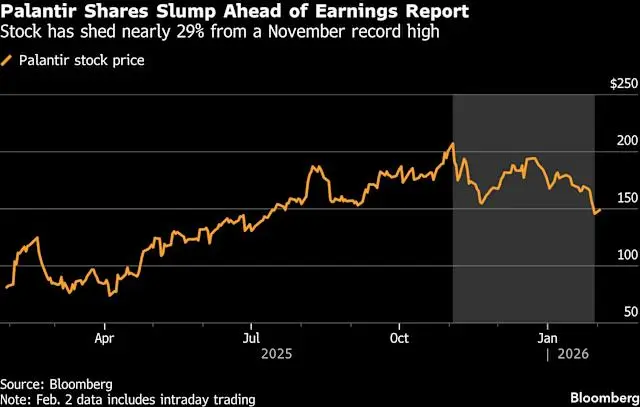
Shares of the software company have fallen approximately 29% since their November peak, which occurred just before Palantir last announced earnings, and are down more than 15% to begin 2026, ranking among the 15 worst performers in the S&P 500 this year. While the selloff has reduced Palantir's valuation, the stock still trades at over 142 times projected earnings, the third-highest multiple in the S&P 500.
Despite its high price, Wall Street expects Palantir to deliver another quarter of strong growth. Analysts covering the company expect adjusted earnings per share will rise 63% to 23 cents in the fourth quarter of 2025. Revenue is estimated to be $1.3 billion, up 61% over the same period last year.
"Investors are looking for 'show me' results and valuation — attractive investments, basically," said Mark Giarelli of Morningstar Investment Service, who rates Palantir shares as sell with a price objective of $135. Palantir stock rose as much as 3.3% during intraday trade on Monday.
Palantir's earnings come amid growing cynicism about Big Tech, with investors demanding returns on their large investments in artificial intelligence infrastructure.
"This is a comforting reflection that it is growing into investor expectations, and that investors are not ratcheting up hopes in a too irrational way," Nguyen wrote in a message to subscribers. "He's well known to bust out the pompoms for his company," Behan told me. "Frankly I'd be shocked if he can't rally some buyers no matter what the report shows."
Other Companies: Earnings and Stock Movements
NXP Semiconductors - Shares fell roughly 6%.
- + Teradyne - Teradyne's robotics stock jumped 20% after the company offered positive forecasts for the current quarter.
- + DaVita - Shares of the kidney care firm rose 12% in extended trading.
- +Fabrinet - The electronic manufacturing services company's stock fell 6%.
- + Rambus – The semiconductor business fell nearly 15% during extended trade.
- +Woodward — Shares of the aircraft component company rose about 15%.